
Design events this November span film screenings, museum shows and large-scale installations, offering a mix of historic retrospectives and forward-looking projects for anyone tracking art, architecture and design trends.
Film festivals and architecture screenings
The Architecture and Design Film Festival arrives in Toronto with a program that examines the human side of building practice. The Tower that Built a City treats the CN Tower as a “living character” and follows its journey from ambition-driven project to cultural icon. The lineup also includes Bauhaus Forever, which imagines a new museum rising beside the historic design school, and Googie, a tribute to Los Angeles’s space-age modernism.
One documentary, Out of the Picture, investigates how women’s contributions to architecture have been erased and how contemporary practitioners are reclaiming visibility. Another feature, Barbara Buser — Swiss Pioneer of Sustainability, follows a living architect who rescues buildings from demolition and rebuilds them with reclaimed materials.
On Saturday, November 7, AZURE will moderate two talks. The first, “Young Climate Stories,” screens three short films about a desert garden in an Algerian refugee camp, a lake-restoration effort in Bolivia and a Lebanese entrepreneur turning agricultural waste into fuel. Later that evening the conversation will shift to “Five Living Buildings,” a deep dive into projects by Renzo Piano.
Exhibitions spotlighting designers and artists
LACMA opens Paul R. Williams: Architect for Living on November 15, with a survey of the Black American architect’s work from the 1920s through the 1970s. Curated by Staci Steinberger and Sarah Locke, the show presents more than 120 drawings and photographs, many unseen before, and is supported by a dedicated website that maps Williams’s Southern-California projects.
In Toronto, Koffler Arts hosts Lessons in Objectology, a solo show by sculptor Gord Peteran that runs until November 8. The exhibition fills a repurposed classroom with uncanny objects, a harp-case wunderkammer, a tiny room-within-a-room and a chair suspended in a fractured metal frame, each probing the gap between an object’s past life and its present meaning.
Across the hall, Cybèle Young’s Kamiphony continues through December 13, offering kinetic paper machines that move without functional purpose. The work references a lineage from Aristotle to Jean Tinguely, suggesting that “uselessness” can still be aesthetically compelling.
The Powerhouse Museum in Parramatta, Sydney, presents a black-box installation titled The Mall, exploring the evolution of the shopping centre as an urban type. Curated by OMA/AMO, the exhibit is organized around five thematic nodes, Desire, Arcade, Transaction, Ideal City and Forum, arranged on a continuous floor that mimics a suburban car park, allowing visitors to explore the space in a way that is similar to a real mall.
Williams’ Barrier-Breaking Career and Peteran’s Symbolic Object Transformations
Paul R. Williams was the leading Black American architect in an era of overt racism. He learned to sketch upside down to convey ideas to white clients who would not sit beside him. At the Beverly Hills Hotel, his signature project, he could not enter through the main door. Yet he shaped Los Angeles and beyond from the 1920s to the 1970s, designing thousands of buildings.
One 3D work places a tiny Mona Lisa print within a maze of tubes, wires, knobs and a horseshoe. Peteran calls this a “chasm of possible ways to ‘re-store’ the performative nature of every thing in every home.” The show runs until November 8, offering viewers a chance to examine everyday objects anew.
Read Also: Muuto seeks outdoor furniture designs
Paris and Buffalo highlights
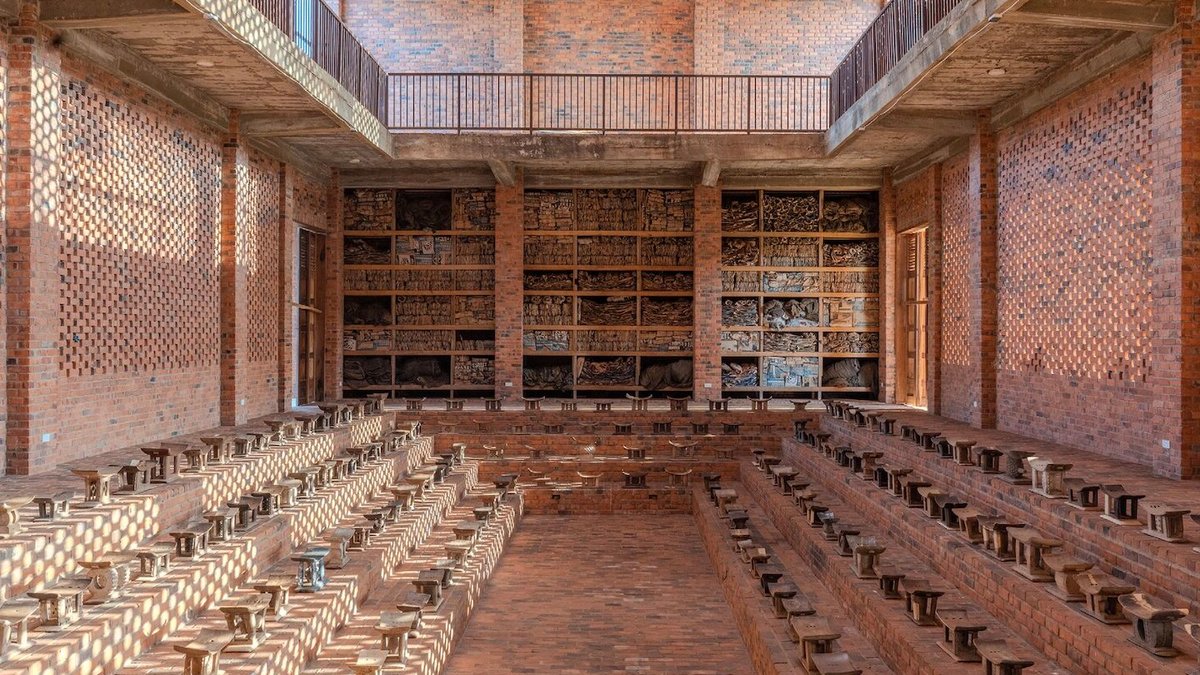
The Fondation Cartier’s Harvest Season opens with Ibrahim Mahama’s Parliament of Ghosts, a chamber of Asante stools echoing “reverse restitution.”
Mahama’s installation re-inserts African craft into a European museum, alluding to a 1966 Ghanaian coup and a vacant parliament.
Things Fall Apart follows, reconstructing components of a 1966 Ghanaian glass factory in Tamale, turning industrial heritage into a learning environment.
A textile façade piece stretches across the museum’s front, visible from the Place du Palais-Royal, weaving Ghanaian motifs into the Parisian streetscape.
Buffalo AKG’s Light in the Window, curated by Holly E. Hughes, gathers forty artists to examine “home” as both idea and place.
Janine Antoni’s Inhabit presents a hybrid half-spider, half-hermit-crab figure, probing motherhood and bodily transformation.
Do Ho Suh contributes Hub-2, a polyester-fabric and stainless-steel work referencing a Seoul address, exploring memory and migration.
Milano and New York design showcases
Triennale Milano hosts Costantino Nivola: Sculpting the Wind, displaying over two hundred pieces that trace his sand-casting legacy.
Nivola’s unrealized Pergola Village imagined umbrella-linked homes across his native Orani, a concept still discussed by scholars.


