
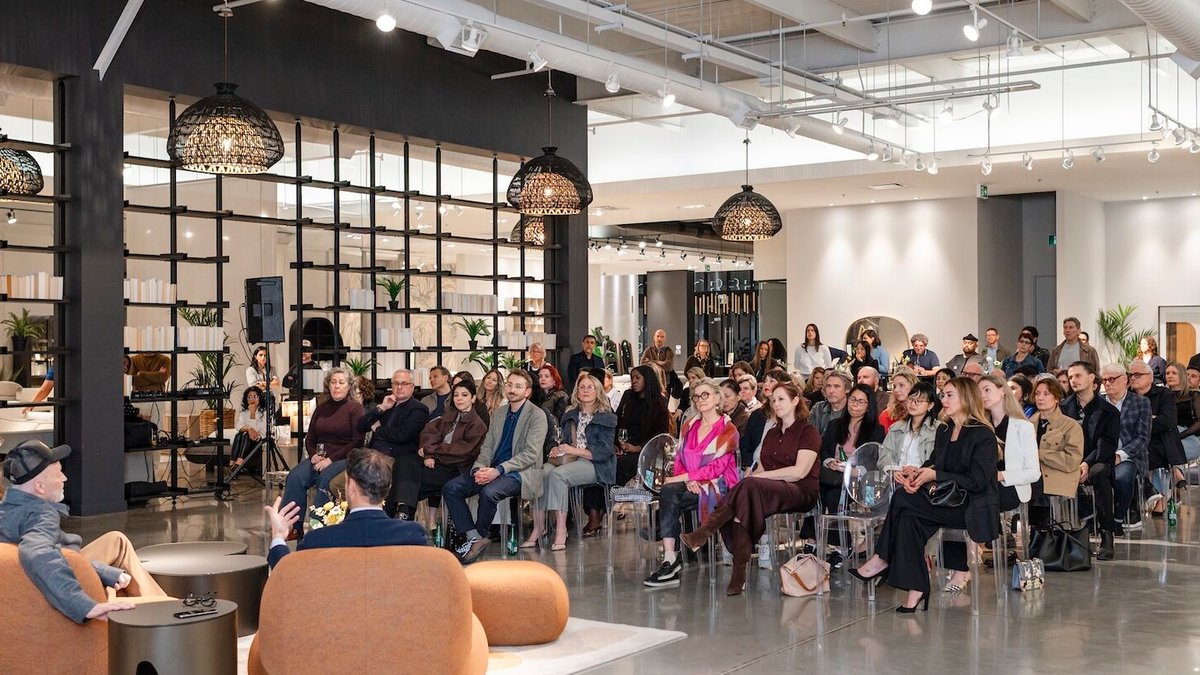
Glenn Pushelberg and Antoine Roset recently shared insights on collaboration, inspiration, and creating design that lasts. The conversation, hosted by AZURE, took place at MUST Société in Toronto and covered various topics, including their approach to design and the importance of preserving French patrimony.
Roset, co-CEO of Ligne Roset, emphasized the importance of finding the right match when working with designers. He explained that the company’s process involves meeting with designers, discussing ideas, and developing prototypes. This approach can take time, with some products taking up to two years to develop. “When we work with a designer, we have to be sure that we match well with them,” Roset said. “We have to meet, we have to discuss, and it’s like the French way around the table — we can speak for hours around the meal. That’s very important. We have a back and forth.”
Pushelberg, one half of the world-renowned studio Yabu Pushelberg, stressed the importance of self-criticism in design. He noted that his studio debates the merits of their designs, ensuring that they are thoughtful and complete. Pushelberg also highlighted the importance of considering various elements, such as scale, proportion, materiality, lighting, and art, when creating a design. “You have to start with really good work,” he said. “You have to be self-critical, because that way you can make your work better.”
Evolving Design Legacy
Antoine Roset discussed Ligne Roset’s evolution since 1860, noting that the company has heritage and cannot change its approach completely. Instead, the company focuses on evolving and giving something to the next generation. Roset also explained that the company is adopting a slower tempo, releasing fewer collections of lasting relevance rather than chasing fleeting trends. “My shareholders are my sister, my brother, my colleagues. So I have to deal with that, but it’s a lot of fun.”
Glenn Pushelberg shared his experience working with European furniture businesses that are family-owned. He observed that these families are deeply invested in their companies and have a clear understanding of what they are making. Pushelberg also noted that when companies are acquired by private equity, they can lose freedom and the ability to make immediate decisions. “The truth is, there’s too much furniture,” he said. “And now the luxury fashion companies have much more capital than the traditional furniture companies involved in furniture. And the furniture companies, some of them are focusing on branding more so than product, which can lead to overexposure.”
Premium Not Luxury
Antoine Roset explained that Ligne Roset does not consider itself a luxury brand, but rather a premium brand. He noted that the company manufactures 83% of its production in France. Roset emphasized that the company uses premium materials and aims to provide lasting relevance in its designs, while maintaining a focus on carbon neutrality across the entire design, manufacturing, and delivery process.
Antoine Roset discussed the importance of considering the function of a design, not just its artistic value. “If I have a beautiful seat that is not comfortable, or beautiful but not strong and durable, it’s not good design,” he said. “They’re two different worlds: artistic creation and design, which has a function.” The company’s approach to design involves a collaborative back-and-forth process with designers, resulting in pieces like the Pukka lounge, which took three years to develop. Another product with Yabu Pushelberg is set to be released this year.


