
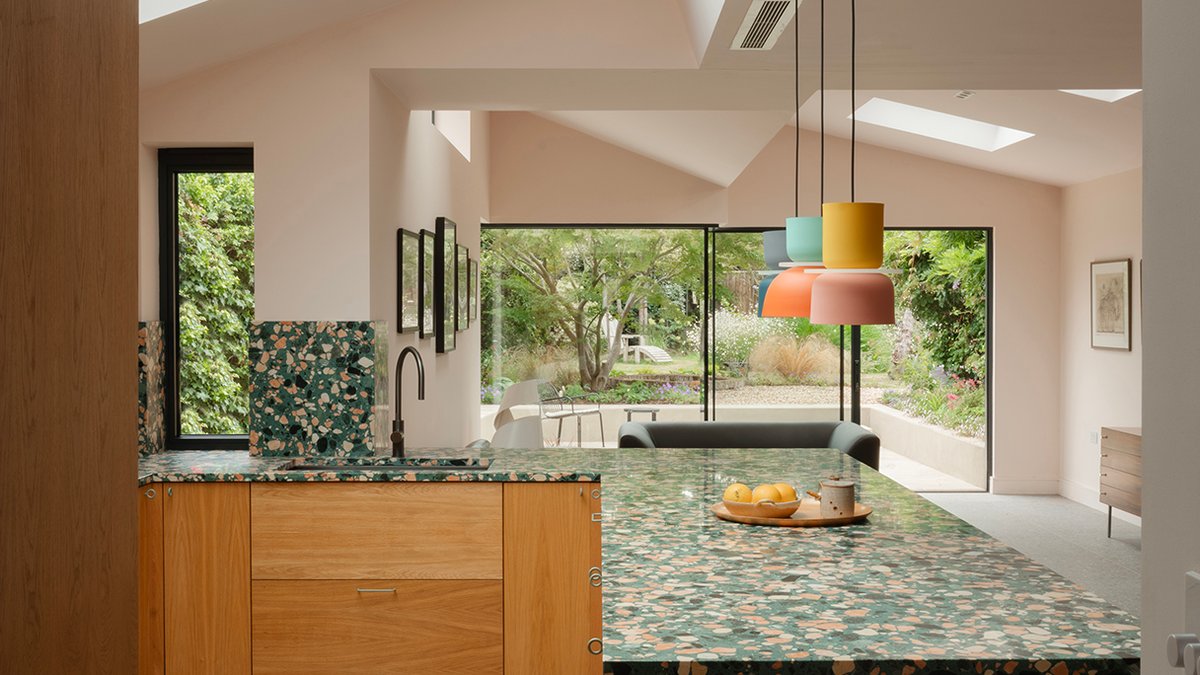
With retirement on the horizon and sustainability a priority, Richard and Liz Templer chose not to move, but to retrofit and extend their period home in southwest London. The couple bought their three-bedroom early Victorian house many years ago, raising their family there. The surrounding area offers plenty of local facilities, and Richard, a retired professor of climate innovation at Imperial College, says the location has everything they need.
Reimagining a Dark Victorian Interior
The home was in poor condition when they bought it. Over the years, Richard and Liz made improvements, including a conventional rear extension. However, living in the house felt disconnected. The original layout consisted of many separate compartments that cut off views of the garden and isolated rooms from one another. The couple turned to Francesco Pierazzi Architects (FPA) to rethink the space.
FPA designed a 180-square-metre extension that replaces the old structure with a contemporary, sustainable design. The layout creates a generous open-plan area, zoned into a kitchen, dining space, and a garden room. The most striking feature is the sawtooth roofline, inspired by local industrial history. This design, which uses skylights on shallow ceiling angles, brings natural light deep into the building. The skylights face east, flooding the space with morning light.
While the project was underway, Richard and Liz faced a messy retrofit to the original parts of the house. The focus was on improving wall insulation. The couple used Kingspan insulation in many areas, but limited space in the narrow Victorian hallway required a different approach. There, they installed ultra-thin Aerogel insulation. This material added just 13mm to the wall depth while improving thermal performance.
Despite the principled approach to environmental sustainability, the couple’s initial application to the local planning department was rejected. Richard says they wanted to use timber for its lower carbon footprint, but officials advised against it. Undeterred, they reapplied for an extension built more conventionally with breeze-block clad in ‘weathered yellow stock’ brick.
Related Post: Nature-inspired home features lush green kitchen
Upgrading the heating, hot water, and ventilation systems was essential for the home’s new efficiency. Richard specified an air-source heat pump for both heating and hot water. A mechanical ventilation system with heat recovery maintains fresh air circulation while reusing heat from stale air. Richard monitors the building’s energy use and reports that the total consumption is less than 25% of what it was before.
For every 1kWh of electricity consumed, the heat pump delivers 4kWh of heat. Richard and Liz also installed air conditioning to cope with recent hot summers. Although this increases electricity use, the home’s overall efficiency has improved so much that, even with air conditioning and EV charging, their electricity bill has reduced by 10%.
A Happy, Low-Carbon Home
Richard and Liz also installed a 7,500-litre underground water tank to cope with hotter summers. Collecting rainwater helps manage the changing climate, allowing them to keep plants green even during dry periods. Inside, the design reflects the couple’s desire to ‘have fun.’ Pale pink walls and a playful terrazzo worktop define the space. Francesco describes how the skylights, angled ceilings, and pastel hues differentiate the areas and guide the eye to moments of delight.
Adapting to the Local Climate
Collecting rainwater allows them to maintain their garden even when rainfall decreases. Richard notes that recent weather patterns mean less rain, but it arrives in shorter, heavier bursts. Storing this water has proven essential for keeping plants green during dry periods.


